Ducon Tile Joint Filler (Epoxy Based)

Epoxy Tile Joint Filler

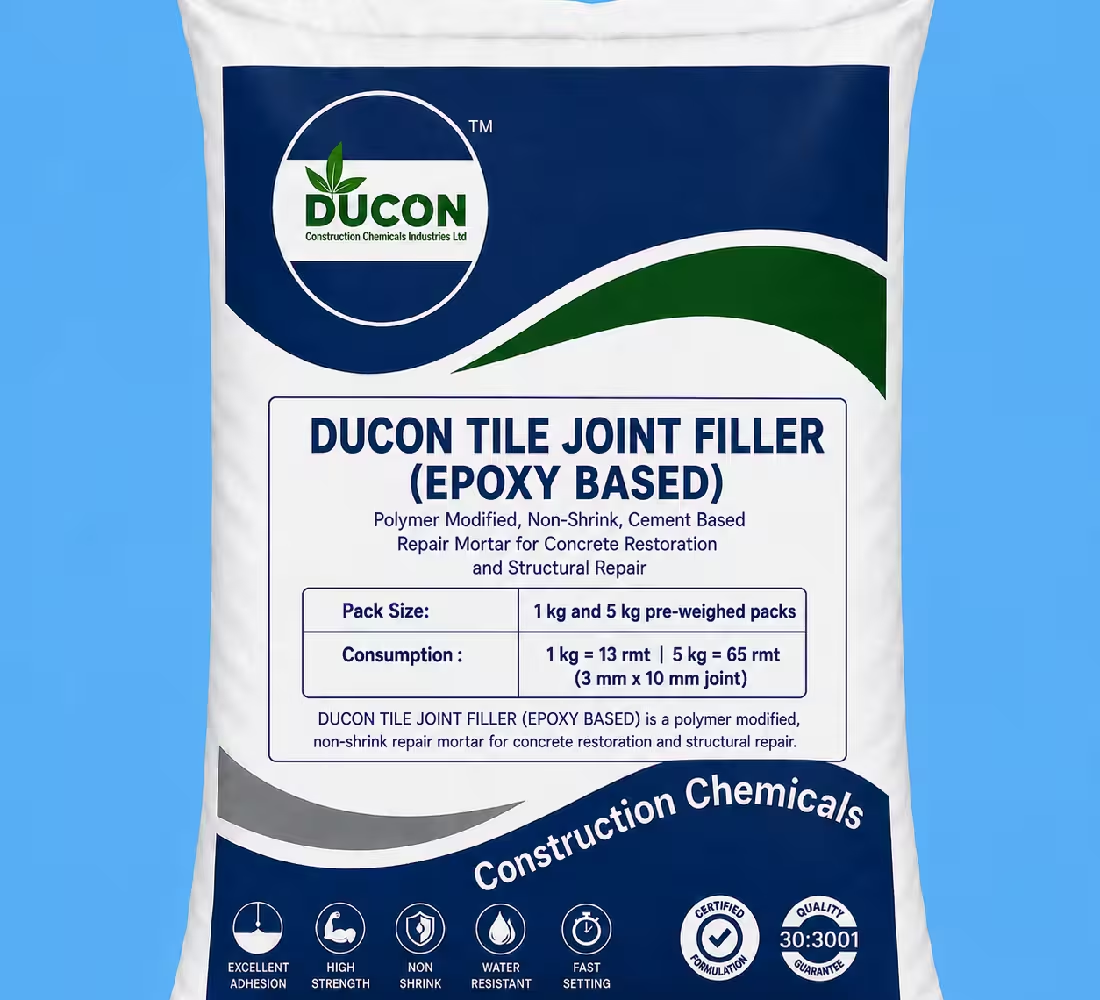
Manufactured by Ducon Construction Chemicals Industries Ltd. at our Gazipur facility, Ducon Tile Joint Filler (Epoxy Base) is a water-miscible epoxy resin grout for tile joints in areas where cement-based grout does not survive. It is supplied in pre-weighed packs for on-site mixing. Compressive strength exceeds 75 N/mm² at 7 days, water absorption is under 0.1%, and the cured joint resists acids, alkalis, oils, and food chemicals. Specifiers and procurement teams comparing epoxy tile joint filler price in Bangladesh get factory-direct supply with full test data behind every pack.

Pack Size:

1 kg and 5 kg pre-weighed packs

Consumption:

1 kg = 13 rmt | 5 kg = 65 rmt (3 mm x 10 mm joint)
Duconmix WPR 700
Ducon Tile Adhesive
sqr012-col2

What is Epoxy Tile Joint Filler ?

There is a category of tiled floor in Bangladesh that no cement grout can hold. Think of a food processing hall washed down twice a shift, a pharmaceutical corridor mopped with disinfectant, a hotel kitchen where fryer oil reaches the floor, or an apartment lobby that a cleaner scrubs with diluted hydrochloric acid every Friday. In all of these, the tile stays fine and the joint fails. It recesses, chalks, darkens, and turns into a channel that traps whatever gets spilled on it. Re-grouting with the same cement product simply resets the clock.

Ducon Tile Joint Filler (Epoxy Base) is built for exactly those conditions. It is a three-part system, base resin, hardener, and graded filler, blended on site into a workable paste. Once cured, the joint is no longer a porous cement matrix. It is a solid, sealed epoxy with water absorption below 0.1% under ASTM D 570 and shrinkage under 0.1% under ASTM D 955. Nothing soaks in, so nothing stains. The material is water-miscible and solvent free, which means it can be used in confined interiors and in occupied buildings without the ventilation problems that solvent-borne systems bring.

Water-reducing Concrete admixture
sqr012-col2
Ducon Tile Adhesive

Application Process

1. Joint Preparation:

Joints must be clean and free of dust and debris before any mixing starts. Remove spacers, vacuum the joint, and confirm the surface is dry. On a re-grouting job, the old cement material has to come out to full joint depth. Epoxy laid over a weak, crumbling cement layer inherits that weakness and lifts with it.

2. Mixing:

Transfer the base and hardener into a clean container or secondary pail and mix for 30 seconds with a margin trowel or slow-speed drill mixer. Add the filler component next and blend with a slow-speed paddle until the mix is uniform and lump free. Filler content can be adjusted slightly to tune consistency, stiffer for a rough finish, softer for a smooth one. Mix complete packs only. Splitting a pre-weighed pack by eye changes the resin-to-hardener ratio and the joint will not reach its stated strength.

3. Application:

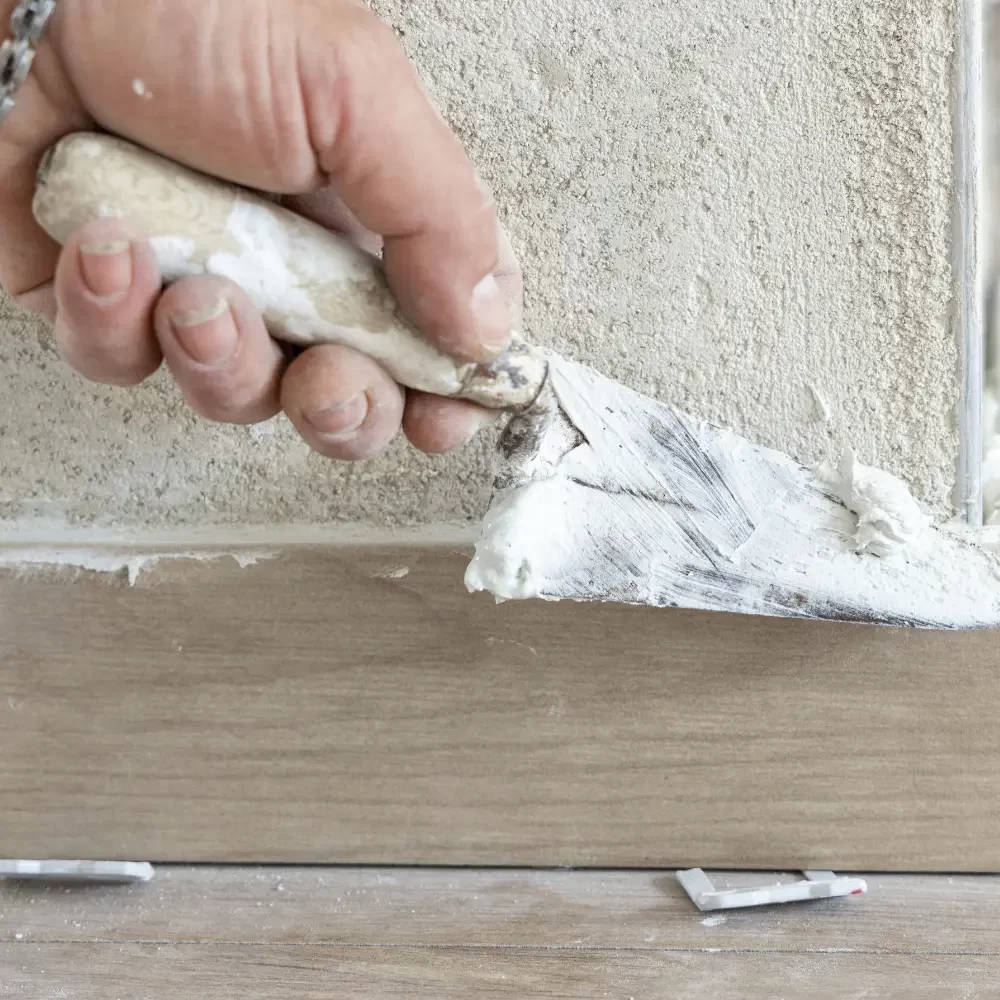
Compact the grout into the joints with a hard rubber grout float, making sure each joint is filled to the full depth. Work in small areas. Strike off the excess diagonally across the grout lines, never parallel, or the float will pull fresh material back out. Plug open-ended joints with a stiffer mix so the grout does not slump. Where food preparation areas next to the work are still operating, segregate them physically and keep the area ventilated, even though the tainting risk is very low.

4. Initial Cleaning:

This step has a clock on it. Within 30 minutes of application, clean off the surplus using an emulsifying pad and gripper dampened with clean water, working in a circular motion with the pad held flat to the tile. Warm water is not essential but makes emulsification noticeably easier. Keep water out of joints that have not yet been grouted. Then lift the emulsified epoxy and water residue with a fine sponge, working diagonally so you do not drag material out of the joint, and tool the joints to finish.

5. Haze Removal:

A light haze may remain on the tile face. Remove it the following day with the emulsifying pad and an alkaline detergent. Do not leave haze on the surface beyond 24 hours. After that it has to come off mechanically, which risks scratching the tile. Clean tools and equipment with water immediately after use, for the same reason: once the epoxy sets, only abrasion will shift it.

6. Curing, Limitations & Precautions:

The joint takes foot traffic after 24 hours and reaches full cure at 7 days. Wet areas such as showers, swimming pools, and fountains must stay out of service for at least 2 weeks after grouting is complete. Do not apply below 5°C or when temperature is falling, and do not expose fresh work to moving water. The product is epoxy based, so wear gloves and use barrier cream throughout; eye contact causes irritation and needs immediate flushing with clean water and medical attention. Store unopened packs in dry conditions, high heat and humidity shorten the 12-month shelf life.

Properties: Water-reducing Concrete admixture

Water-reducing Concrete admixture
Ducon Tile Adhesive
sqr012-col2

Key Features:

Benefits: Ducon Mix 700

For facility and plant managers: the joint stops being a maintenance line item. In food, dairy, beverage, and pharmaceutical plants, joints that absorb spillage are an audit finding waiting to happen. A non-porous, bacteria-resistant joint takes daily washdown and disinfection without breaking down, so hygiene compliance does not depend on how carefully the cleaning crew works.

For contractors and project managers: a 45-minute minimum pot life at 27°C gives a realistic working window in Bangladeshi site conditions, and the 24-hour foot traffic figure allows floors to be handed back quickly on phased fit-outs. Fewer defect-period callbacks follow from a joint that does not shrink, crack, or discolour.

For homeowners and interior clients: this is the answer for anyone who has re-grouted the same kitchen twice. As a stain-proof tile grout, it does not absorb oil, turmeric, tea, or cooking residue, so the joint stays the colour it was laid in. People searching for the best epoxy grout for kitchen surfaces are usually solving a staining problem, not a structural one, and an anti-stain tile grout addresses it at the source rather than through repeated cleaning. structures where re-entry for repair is expensive.

For procurement and specification teams: published values against ASTM and BS test methods mean the product can be written into a tender document and verified on delivery. Where industrial epoxy tile grout cost is being compared line by line across suppliers, the meaningful comparison is coverage against documented performance, not price per kilogram in isolation.

Water-reducing Concrete admixture
Ducon Tile Adhesive
sqr012-col2
Water-reducing Concrete admixture
Ducon Tile Adhesive
sqr012-col2

Ducon Mix 700 : Usages Area

Applications & Use Cases

01

Food & Beverage Processing Plants

The clearest case for epoxy. Floors here face fruit acids, dairy residue, edible oils, and caustic washdown, sometimes within the same shift. Verified resistance to dairy products, fruit juices, soft drinks, and edible oils under ASTM D1308 keeps the joint intact and non-absorbent, which is what hygiene auditors look for.

02

Pharmaceutical Plants & Laboratories

Cleanroom-adjacent corridors and lab floors are disinfected constantly. A bacteria-resistant, non-porous joint holds up to that routine, and because the system is solvent free it can be installed inside occupied buildings without shutting down surrounding areas.

03

Commercial Kitchens & Hotels

Hot water, fryer oil, and daily degreasing destroy cement joints within a season. An epoxy grout for kitchen tiles resists the oils and detergents directly, so back-of-house floors stay serviceable between refurbishment cycles instead of needing annual attention.

04

Factories, Workshops & Warehouses

Where pallet trucks and trolleys run, the joint wears before the tile does. Compressive strength above 75 N/mm² with good impact resistance keeps the joint level with the tile face, and epoxy grout for industrial floor applications is specified for exactly this reason. An epoxy joint filler for industrial tiles also takes the point loading that trolley wheels concentrate on the joint edge.

05

Hospitals & Health Centres

Wet-cleaned wards, treatment rooms, and sluice areas need joints that neither harbour bacteria nor absorb spills. Non-staining, easily cleaned joints support infection-control routines rather than working against them.

06

Swimming Pools & Fountains

Continuous immersion plus chlorine is the hardest chemical duty a tile joint faces. Water absorption below 0.1% and resistance to treated water make this the correct specification, provided the pool stays out of service for 2 weeks after grouting.

07

Shopping Malls & Airport Terminals

High footfall grinds joints into dirt traps. Abrasion resistance combined with a non-porous surface means the joint keeps its colour under thousands of passes a day, and cleaning crews can restore appearance without aggressive chemicals.

08

Apartment Lobbies & Common Areas

Acid-based floor cleaning is standard practice in Bangladeshi building maintenance and it eats cement joints. Where that routine cannot be changed, a chemical proof tile joint filler is the practical fix. Management committees usually recover the extra cost within two avoided re-grouting cycles.

09

Wet Rooms & Premium Bathrooms

Shower floors, steam rooms, and hotel bathrooms combine constant moisture with visible finish quality. The joint resists mould growth and holds its shade, which matters where a discoloured grout line is the first thing a guest notices.

Quality Assurance & Compliance

ISO 9001:2015

Quality Certified

TDS & MSDS

Available on request

Laboratory Tested

Quality Verified Products

Bulk & Export

Factory-direct dispatch

Frequently Asked Questions

Epoxy grout is made of three parts: an epoxy base resin, a hardener, and a graded filler. Mixing the base and hardener starts a chemical reaction that cures the material into a solid plastic rather than letting it dry like cement. Ducon supplies all three components pre-weighed in one pack, so the ratio is fixed and site staff do not have to measure anything. The mixed material is water-miscible and solvent free.

A correctly installed epoxy joint typically lasts the service life of the tiling itself, often 15 to 20 years or more, because it does not shrink, absorb water, or break down under normal cleaning chemicals. Cement joints in the same conditions usually need re-grouting every 2 to 4 years. The failures we do see in epoxy joints almost always trace back to installation, either joints that were not clean or packs that were split and mixed off-ratio.

Yes. Ducon Tile Joint Filler (Epoxy Base) is used on both wall and floor tiles, and wall joints in showers, kitchens, and laboratories are among its most common applications. On vertical joints, use a slightly stiffer mix by adjusting the filler content so the material does not slump before it sets, and plug any open-ended joints first.